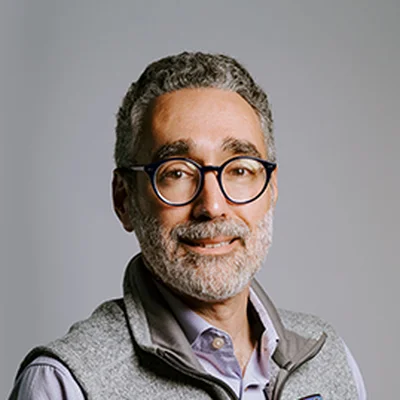
Who Erik Nieves is
Nieves founded Plus One in San Antonio, Texas, in 2016 after a long career at one of the largest industrial robot makers. He serves on the board of the Robotic Industries Association and speaks often on robotics policy.1,2
Twenty-five years at Yaskawa Motoman
Nieves spent more than 25 years at Yaskawa Motoman Robotics in leadership roles in the US and abroad. As technology director he was responsible for the technology roadmap and emerging applications.2
In 2010 he mapped robotics development work across the Americas and noticed the open-source Robot Operating System showing up everywhere. In 2013 he presented at the first meeting of the ROS-Industrial Consortium and became Yaskawa Motoman's representative to it, and in 2014 he worked with NASA on remote human-in-the-loop control for satellite servicing.1
Machines are fast, precise and great at high-volume tasks, but they aren't naturally adaptable when something unexpected comes up like a crushed box, an oddly shaped parcel.Erik Nieves, Robotics and Automation News, October 7, 2025
Founding Plus One Robotics
Nieves founded Plus One Robotics in 2016, with Shaun Edwards, a ROS-Industrial pioneer, joining as co-founder and Paul Hvass joining as a co-founder in 2017. The company came out of stealth in 2018, and its first robots went to the FedEx hub in Memphis, Tennessee, in 2020.1
He was named to the board of the Robotic Industries Association in 2021, the year Plus One raised its Series B. In March 2023 the company raised $50 million, which Nieves said would mostly go to sales expansion.1,3
Keeping humans in the loop
Plus One's systems hand hard cases to remote crew members rather than stopping the line. Nieves has described the reason in plain terms: robots are fast and precise but do not adapt well when something unexpected arrives.2
Links
Sources
Photo: Plus One Robotics, About.